Australian Surrogacy Law: Setting the Record Straight on Misleading Claims
Response to op-ed in The Australian by Stephen Page
On Wednesday, a UK writer and anti-surrogacy advocate wrote an op-ed in The Australian. I first became aware of the article when my colleague Sarah Jefford OAM told me.
For some reason, the author conflated transmen giving birth with surrogacy ( I am still missing the connection), then said that the Australian Law Reform Commission was recommending commercial surrogacy in its surrogacy review (it isn’t), then left the worst to last, with statements about me.
I contacted The Australian by phone on Thursday. There is no way to email its editorial team, other than letters to the editor. My call has still not been returned. On Friday, I sent my response as a letter to the editor. It was not published.
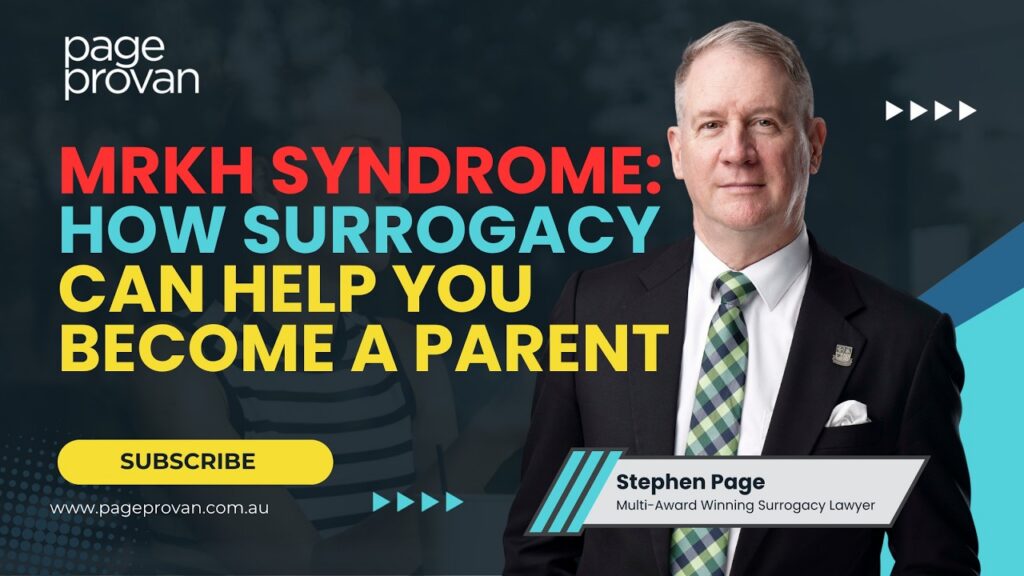
My first surrogacy case was in 1988. I have advised in over 2,000 surrogacy journeys since then. I first acted for a surrogate in 2010- and there have been many since. I am a dad through surrogacy- in Australia. I have written, spoken at hundreds of seminars, and lectured about surrogacy around the world, and given expert evidence. I have also been a member of many committees to do with surrogacy and IVF.
Here is my response to the op-ed:
“The op-ed by Julie Bindel warning about the impending doom of there being commercial surrogacy in Australia, and taking a potshot at me is, frankly, embarrassing that it was published by The Australian without some basic fact checking. The Australian Law Reform Commission is not advocating for commercial surrogacy, as she claimed, as a simple read of its latest discussion paper makes plain.
Bindel claims that I made a significant submission to the Australian Law Reform Commission in which it is said that I falsely claimed that the UN Special Rapporteur, Ms Alsalem (who has called for all surrogacy to be “eradicated”) “has not consulted with surrogate mothers during her research.” I made two submissions: one in July and one in December. I did not make the claim in either submission.
Bindel also says that I can “be seen can be seen on video publicly misrepresenting Alsalem’s position on surrogacy.” Alsalem’s position is plain- that all surrogacy should be “eradicated”. As the context of my video made plain, I took part in one closed door session, of two, that the Special Rapporteur held. In my session there were many anti-surrogacy advocates- but there was no IVF specialist, there was no parent through surrogacy (aside from me), there was no fertility lawyer (aside from me), there was no surrogate and nor was there any child born through surrogacy. It is clear that my comments in the video relate to the one closed door meeting in which I took part. I cannot say what occurred in the other closed door meeting, as I was not there. I am not aware who attended, and the Special Rapporteur has not, to my knowledge, said.
My experience of surrogacy in Australia is that I have not seen any evidence of violence towards surrogates. Instead, there have been reported cases of a surrogate seeking to defraud intended parents (by claiming that she had lost the baby, when she had not) and of a surrogate seeking to extort intended parents (and withhold twins). These cases have been dealt with firmly by the courts, as they should be.
Contrary to Bindel’s assertion that I am “totally out of touch with surrogate mothers’ experiences”, I have for many years acted for surrogates. It is a great honour to represent them. Surrogates are extraordinarily generous women who ought to be cherished.
For over a decade, I and others have advocated for the law to be changed so that surrogates have bodily autonomy. That advocacy has resulted in law changes in most states upholding that basic right, most recently in Western Australia.
I take human rights very seriously, as I have always done. In 2018, for example, I persuaded the then South Australian Attorney-General, Vickie Chapman, to put the human rights of all concerned front and centre in any consideration of surrogacy. Hence section 7(1)(a) of the Surrogacy Act 2019 (SA) says one of the principles of the Act is that: “the human rights of all parties to a lawful surrogacy agreement, including any child born as a result of the agreement, must be respected.”
If The Australian had carried out a basic check of its records, it would have seen that in 2019 it wrote about the birth of my husband’s and my daughter through surrogacy, and how we had to traverse uncertain legal terrain in Queensland at the time. Our surrogate was treated with respect- and love.”