Homophobic violence in Queensland: the shocking reality

Homophobic violence in Queensland: the shocking reality

Groundbreaking research has revealed the shocking extent of homophobic violence in Queensland. Publishing the research in a book: “Speaking Out: Stopping Homophobic and Transphobic Abuse in Queensland”, the researchers, Drs Alan Berman and Shirleene Robinson, have uncovered that over a lifetime:

  • 73% of respondents had been subjected to homophobic verbal abuse
  • 41% had experienced threats of physical violence 
  • 26% had experienced written abuse, such as by email
  • 23% had experienced physical violence
  • 15% had experienced wilful damage to their car
  • 14% had experienced sexual assault without a weapon
  • 45% of male to female transgendered respondents had been sexually assaulted

Gay respondents were more likely to be the victim of violent physical attacks. Lesbian respondents were more likely to be the victims of sexual assaults.
In the last 2 years before the survey was carried out: 

  • 43% of respondents  had been subjected to verbal abuse
  • 25% had been spat at or subjected to harassment
  • 18% had been subject to threats of physical violence
  • 9% had been assaulted

The book reveals harrowing and frightening stories, as well as stories of courage. One respondent stated:
“Last June myself and my partner were physically attacked on the streets [ of Fortitude Valley] by one main offender while his six or seven friends cheered him on. I ended up in hospital with a dislocated shoulder.”
Another respondent stated:
“I was called a ‘dyke’ and was pushed to the ground, kicked in the side by one person and punched in the face by the other. I managed to overpower them and get away as they were intoxicated.”
A transgendered respondent from north Queensland described being:
“spat on twice by a bikie with a mouth full of rum and coke. The first time I confronted him with the security. Second time I called the police who had to pick me up from the rear of the pub for my own and their safety.”
Consistent with international research, the study showed that men were much more likely than women to perpetrate homophobic and transphobic violence.
The research was primarily undertaken by polling almost 1100 respondents, as well as running focus groups from the Gold Coast up to Cairns.
The research, funded by interest from solicitors’ trust accounts, made 36 recommendations for change, including:

  • abolishing the gay panic defence- where a defendant alleges that he assaulted or killed the victim as he thought that the victim was gay and was making sexual advances to him
  • enacting substantive hate crime legislation in the Criminal Code
  • ensure that school anti-bullying policies include reference to same sex attracted and transgendered youth
  • a full time LGBTIQ statewide police liaison officer
  • installing more CCTV cameras in known violence hotspots, such as Fortitude Valley
In her foreword, Justice McMurdo stated:
“The Robinson- Berman survey is the most comprehensive research into homophobic and transphobic  abuse, harassment and violence yet undertaken in any Australian jurisdiction”, and:
“This book should convince all Australians that abuse, harassment and violence motivated  by homophobia or transphobia remain a distasteful and unacceptable aspect of our society. We must do better.”

The book is published by Australian Academic Press, RRP $34.95.

Disclosure: I assisted the authors with legal aspects that arose from the research.
Request an Appointment
Fill in the form below to find out if you have a claim.
Request an Appointment - Stephen Page
Things to Read, Watch & Listen

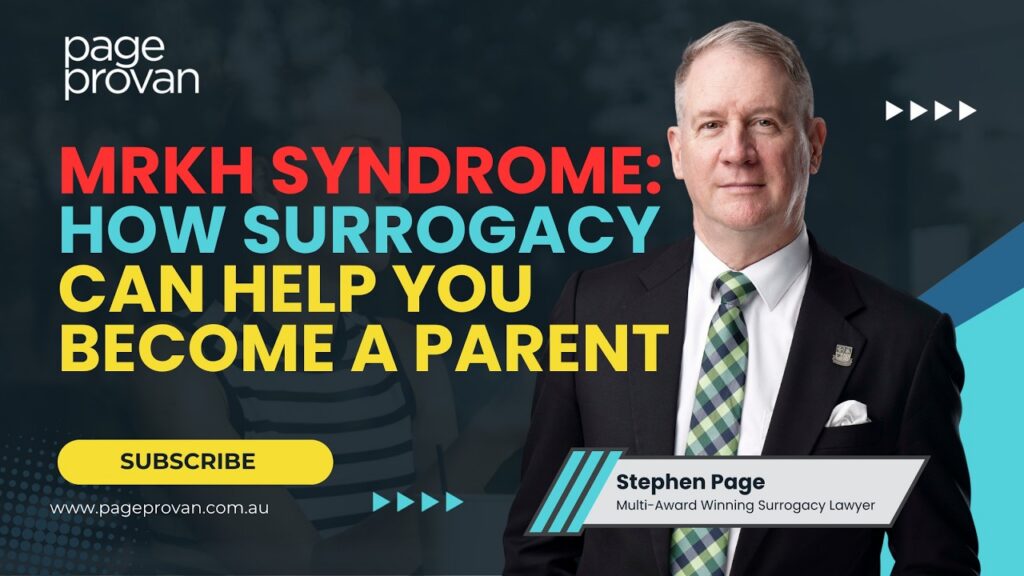
MRKH syndrome: how surrogacy can help you become a parent

MRKH syndrome means being born without a uterus. It does not mean that parenthood is impossible. For women with Mayer-Rokitansky-Küster-Hauser syndrome, often shortened to MRKH, the journey to understanding their body can begin at a young age. Many discover in their early teenage years, commonly around 14 or 15, that they will not be able… Read More »MRKH syndrome: how surrogacy can help you become a parent

Australian Overseas Surrogacy Births Hit Record High Again in 2026 — Here’s Where Families Are Going

Another record year for overseas surrogacy births For every child born through surrogacy in Australia, five are born overseas. Despite laws allowing altruistic surrogacy, the shortage of available surrogates within Australia has meant that the norm is to undertake surrogacy overseas, and the exception is to do so at home. A record 416 Australian children… Read More »Australian Overseas Surrogacy Births Hit Record High Again in 2026 — Here’s Where Families Are Going

Surrogacy statistics: why so many go overseas

Surrogacy is intensely personal, but the numbers tell an important story about how difficult it can be for intended parents in Australia. The central statistic is striking: for every child born in Australia through surrogacy, about four are born overseas. That is not a small difference. It points to a system in which many intended… Read More »Surrogacy statistics: why so many go overseas

Family Law Section Law Council of Australia Award
Member of Queensland law society
Family law Practitioners Association
International Academy of Family Lawyers - IAFL
Mediator Standards Board