What really happens inside the world’s largest ethical surrogacy conference?
When reproductive law meets lived experience, the conversation shifts from theory to practice. At the Society for Ethical Egg Donation and Surrogacy (SEEDS) conference in Orange County, California, nearly 400 professionals came together to do exactly that: talk candidly about how to make surrogacy and egg donation safer, fairer and ethically robust. The gathering offered a valuable snapshot of where the international surrogacy sector is headed—especially around cross-border arrangements, protection of surrogates and donors, and clinical best practice.
What is SEEDS and why does it matter?
SEEDS stands for the Society for Ethical Egg Donation and Surrogacy. It is an industry body that brings together agencies, clinicians, lawyers and people with lived experience to promote ethical standards across the field. The conference is not a trade fair; it is a professional forum focused on policy, practice and the practical issues that arise when families, donors and surrogates interact across jurisdictions.
Who attends—and what surprised attendees
The conference attracts a surprisingly large and diverse group. Around 400 people attended, with a strong representation from US surrogacy agencies and international delegates from countries such as Spain, Mexico and Colombia.
One of the most striking features was the gender composition. Roughly 75 to 80 percent of attendees were women. Many of those women were not just professionals; they were former surrogates, former egg donors, or both. Rather than a room of detached industry operatives, the event was populated largely by people who had personally navigated fertility journeys and who now work to support others through the same process.
Key themes: ethics, clinical safety and cross-border risk
Several themes dominated discussions and panels. These are the issues that inform both day-to-day agency practice and larger regulatory debates.
- Ethical practice: There was a consistent focus on protecting surrogates, donors and the resulting children, with speakers emphasising transparency, informed consent and fair compensation models.
- Single embryo transfer: A widely supported practice among attendees. Many agencies reported mandating single embryo transfer to reduce the medical risks associated with multiple pregnancies for surrogates.
- Hybrid and cross-border arrangements: Moving eggs, sperm or embryos across borders, or engaging surrogates in other countries, raises complex legal and ethical questions. Cost pressures drive many of these arrangements, but trafficking and exploitation risks must be evaluated carefully.
- Reputational risk: Even where a practice is lawful, agencies and professionals are increasingly conscious of ethical reputational risk. Public scrutiny and social licence matter.
Single embryo transfer as a standard of care
One of the most encouraging outcomes at the conference was broad support for single embryo transfer. Attendees—including agency staff and clinicians—were clear that limiting to one embryo reduces the likelihood of multiple pregnancies and the attendant health risks for surrogates and infants. The emphasis on this clinical best practice demonstrates an industry moving towards safer, evidence-based care.
Why the gender make-up matters for the exploitation debate
Public debate often frames surrogacy as a scenario in which men or institutions exploit women. The reality, as seen at SEEDS, is more nuanced. Many of the women working in the industry have been surrogates or donors themselves. Their participation reframes the conversation: they bring a feminist perspective that prioritises autonomy, safety and mutual respect.
This lived experience leads to a practical ethic: measures should be put in place not to restrict agency, but to support it. That includes clear counselling, robust consent processes and clinical protocols that minimise risk.
Hybrid surrogacy: cost, risk and regulation
Hybrid surrogacy arrangements—where gametes, embryos or surrogates cross borders—are increasingly common. They are often driven by cost, but they carry several potential pitfalls:
- Legal uncertainty: Different countries have different rules about parentage, gamete importation and surrogacy contracts. That can create delays or disputes when a child is born.
- Trafficking and exploitation risk: Cross-border movement of people or reproductive material needs careful safeguards to ensure voluntary participation and fair treatment.
- Medical continuity: When care is split across jurisdictions, continuity of clinical records and standards of care can be compromised.
- Reputational exposure: Agencies and intended parents can be subject to scrutiny if a cross-border arrangement appears to take advantage of regulatory gaps.
Professionals at the conference emphasised that hybrid arrangements demand high levels of legal and ethical due diligence. Legal counsel experienced in international reproductive law should be part of the planning process for intended parents considering a cross-border pathway.
Practical takeaways for intended parents and professionals
For those considering surrogacy or egg donation, and for professionals supporting them, the discussions at SEEDS point to several practical steps to reduce risk and improve outcomes.
- Choose agencies that prioritise ethics: Look for explicit policies on informed consent, screening and compensation transparency.
- Prioritise single embryo transfer: Single embryo transfer reduces medical risk and is a strong marker of an agency committed to surrogate welfare.
- Seek specialist legal advice: Cross-border arrangements require lawyers with experience in international family and reproductive law.
- Verify lived experience within teams: Agencies that include former surrogates and donors often have deeper insight into ethical practice and practical support needs.
- Assess trafficking and exploitation safeguards: Ensure clear documentation of voluntariness, counselling records and independent legal advice for surrogates and donors.
Where the industry is heading
The mood at SEEDS was optimistic and pragmatic. Rather than polarised rhetoric, the conversations were rooted in practical ethics and evidence-based clinical practice. There is a clear movement within the international surrogacy community toward standards that centre surrogate and donor welfare, protect children and support intended parents through transparent processes.
That does not make the field risk-free. Cross-border arrangements will continue to pose legal and ethical challenges. But the presence of engaged professionals—many with lived experience—suggests the sector is actively confronting those challenges rather than ignoring them.
Final note
Ethical surrogacy is possible when policy, practice and lived experience align. The SEEDS conference illustrated that progress is occurring through collaboration between agencies, clinicians, lawyers and people who have walked the path themselves. For anyone navigating these pathways, the priorities are clear: safety, informed consent and transparent, ethical practice at every step.
About Stephen Page
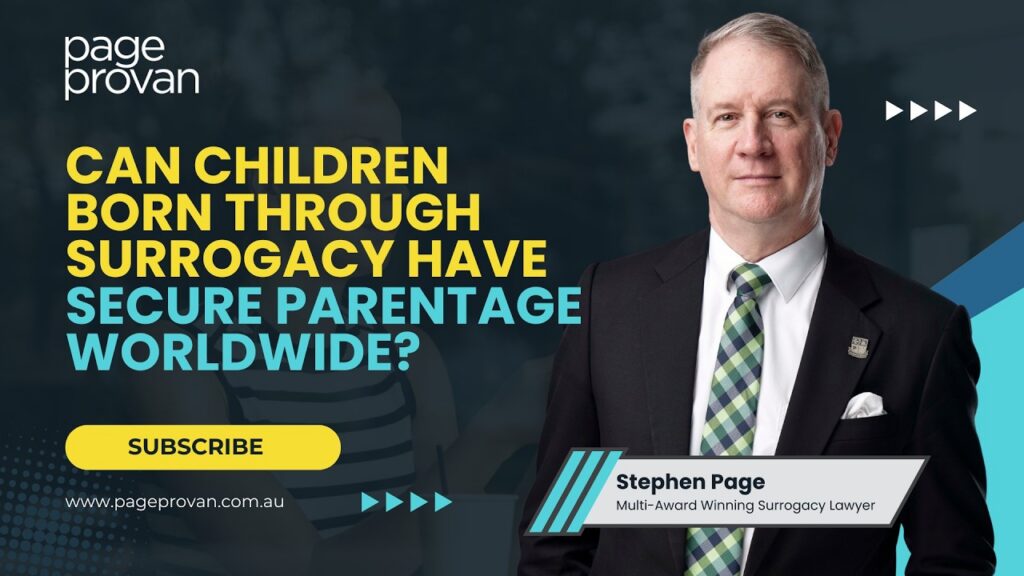
Stephen Page is recognised as one of Australia’s leading surrogacy lawyers. He advises intended parents, surrogates and fertility professionals on complex domestic and international reproductive law matters, and champions ethical, practical solutions that protect families and the people who help create them.