



Overseas surrogacy births are 4 times that of domestic surrogacy births
When talking to colleagues, judges and policymakers, it is assumed that the norm of Australian surrogacy is that of domestic surrogacy births. However, as the most recent figures demonstrate, yet again, domestic surrogacy births are the exception. The norm remains that of Australian children being born through surrogacy overseas.
That norm and the exception have been demonstrated in the most recent figure published by the IVF industry.
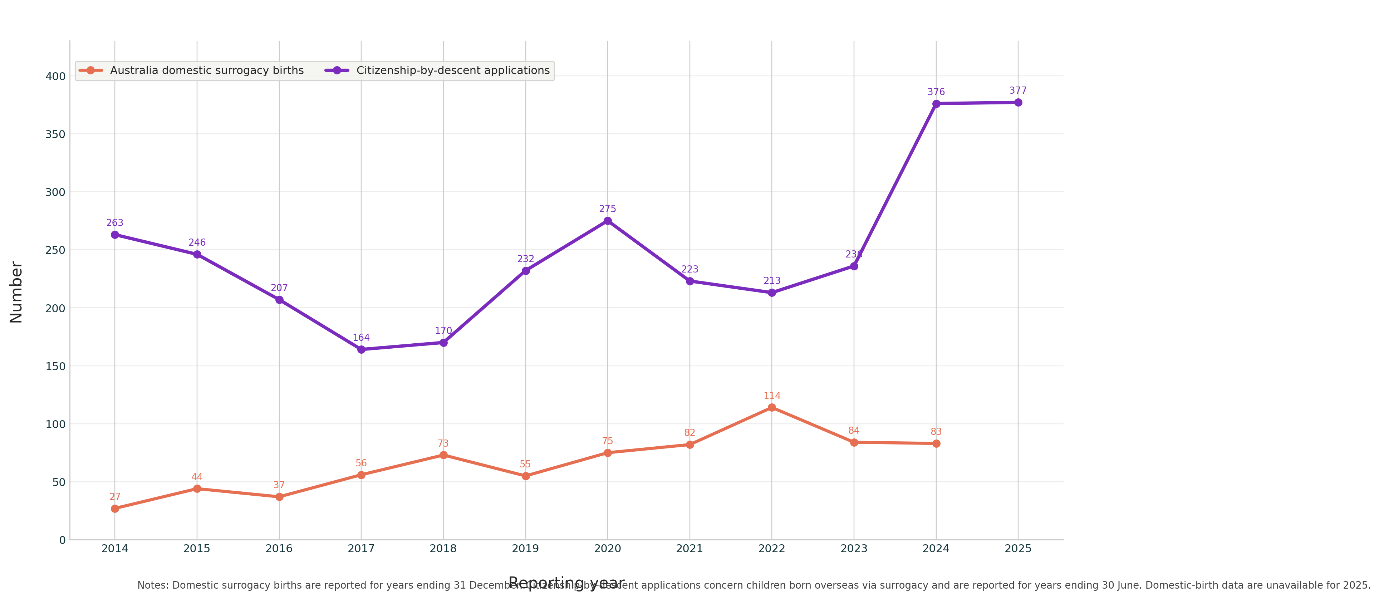
According to the most recent Australian and New Zealand Assisted Reproductive Database report, when adjusted for New Zealand, there were 83 gestational surrogacy births in Australia in the year ended 31 December 2024. This compares with 376 applications for Australian citizenship by descent by children born overseas through surrogacy in the 2024 financial year, and 377 in the 2025 financial year.
ANZARD reported that there were 101 gestational surrogacy births in Australian and New Zealand IVF clinics in the year ended 31 December 2024. ANZARD does not give an Australian specific number. By contrast, the University of New South Wales, which produces the ANZARD report, also produces the annual ART report for New Zealand, published on a financial year basis. This report shows that in the 2024 financial year, there were 18 surrogacy births in New Zealand. Therefore, of the 101 births in 2024, there were about 83 gestational surrogacy births in Australia and 18 in New Zealand.
The figures are a little hard to reconcile, as they cover slightly different reporting periods. New Zealand figures also include traditional surrogacy births approved through the national committee. However, traditional surrogacy arrangements there do not need committee approval, and it seems as a result that few seek that approval.
With the exception of 2022, when there were 114 gestational surrogacy births in Australia, the number of gestational surrogacy births in Australia has been stable: 75 in 2020, 82 in 2021, 84 in 2023 and 83 in 2024.
Data from the Department of Home Affairs makes plain that many more children born overseas via surrogacy apply for Australian citizenship by descent in these financial years: 275 in 2020, 223 in 2021, 213 in 2022, 236 in 2023, 376 in 2024 and 377 in 2025.
As the graph makes plain, the norm is that of Australian children born overseas through surrogacy. The exception is Australian children born in Australia via surrogacy.
The Australian Law Reform Commission surrogacy report is due to be tabled in federal Parliament no later than 18 November. I hope that it recommends reforms that tilt the balance, so that the norm in future is Australian babies born via surrogacy in Australia, and the exception is Australian babies born via surrogacy overseas.
Stephen Page was a member of the Australian Law Reform Commission surrogacy review. He is not privy to the report or recommendations of the ALRC.